
The “Camp Activities” Mystery: Discovering Normandy Airfields

Today’s film presents a mystery. The given title of this Army Air Forces (“AAF”) film found at the National Archives and Records Administration (“NARA”) is simply “Camp Activities”. This is the first of four rolls showing the construction and early operation of an Advanced Landing Ground airstrip in Normandy about 10 days after D-Day, making this one of the earliest Allied airfields in liberated France.

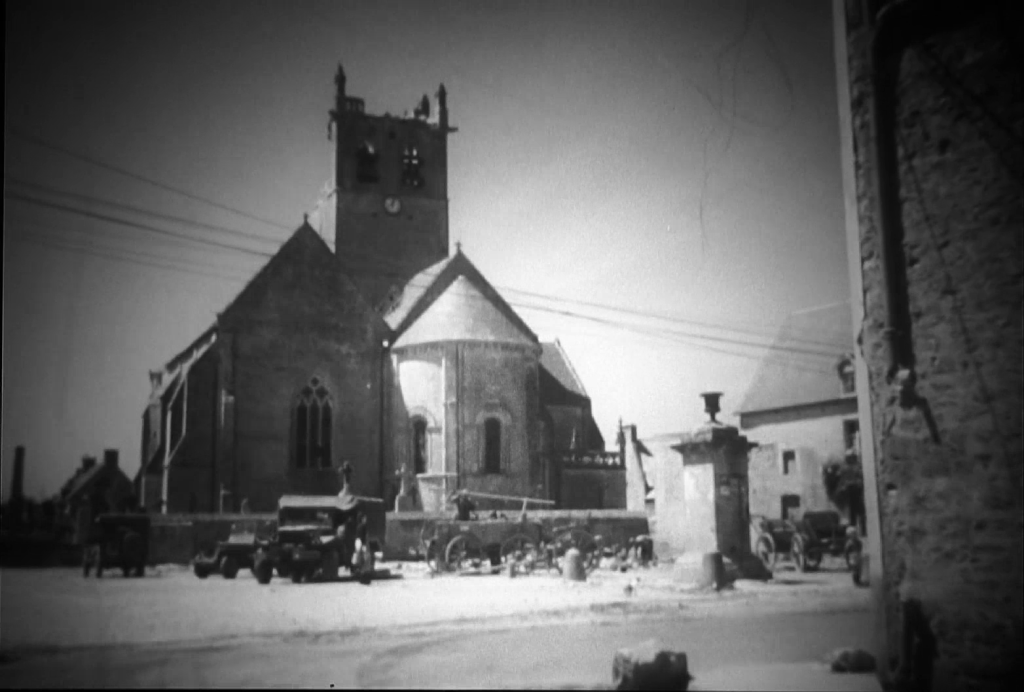
The description provided by the AAF provides no location and the only clue is a brief shot of a local church or abbey at 1:25. It looks like the back half of the church tower is missing.
The strip was apparently setup in a farmer’s field. The camp for Army personnel looks like it was setup next to one of Normandy’s numerous canals, but apparently the soldiers and airmen also setup in nearby wrecked gliders, suggesting this was a glider landing ground on D-Day. The film includes numerous shots of WWII aircraft: P-47 fighters, Spitfires, C-47’s, Horsa gliders, and CG-4A gliders in action (and also as wrecks on the ground).

My suspicion is that this was the Carentan Army Airfield (Advanced Landing Ground A-10), which is today the site of the Normandy Victory Museum. These airfields provided life-saving landing alternatives for aircraft and crews in trouble. They were often used to evacuate casualties as well. I’m hopeful that Norman locals can chime in here to help conclusively identify the site!

UPDATE!

Many thanks to my good friend and colleague Tom Hogan who identifed the church as Saint-Côme-du-Mont near Carentan. Further information received from a Normand suggests this is landing strip A-6, aka Beuzeville/Ste. Mère Eglise airstrip, since it was closer to the glider landing ground that figures so prominently in this film.

Context is critical to gain the full impact of archival film for your production. An experienced archival media researcher can leverage the full power of archives for you!

Aftermath of Battle: Pointe du Hoc

Today we’re continuing our memory visit to Normandy’s Omaha Beach and specifically, the promontory at Pointe du Hoc. If you read our previous post, you know that the coastal artillery battery sited on this high ground was a primary objective for June 6th, the first day of the D-Day assault.

This battery sat atop a 100 foot high cliff and loomed large in Allied planning. The Ranger groups training in the United Kingdom spent months preparing for numerous cliff assault scenarios. The objective was assigned to the 2nd Ranger battalion. Thanks to their training and expert naval gunfire, they achieved their objectives. On reaching the summit, they discovered that a few weeks before D-Day, the captured French artillery making up this battery had been relocated to a nearby orchard. The Rangers found these large guns and disabled them with thermite grenades.

The “featured film” today, from the US Navy motion picture film material at the National Archives and Records Administration, is perhaps the earliest film of the aftermath of the Rangers’ assault. WARNING! This film shows dead casualties of the assault.

The film (identified by my sharp-eyed colleague, Thomas Hogan) opens with a scene of wounded being ferried back to the ships in the English Channel. The action quickly moves to a landing party that appears to be surveying the battlefield. Shell holes and abandoned equipment are all around the tide line. The camera quickly pans the high cliffs from below and settles on a precarious rope ladder. The landing party climbs the ladder, and the following shot scans a scene of desolation. The German strong points have all been demolished, if not by the Rangers, then by naval gunfire support. The party then climbs down the rope ladder, as the camera pans down, recording that the naval gunfire (falling short) had effectively pock marked the tidal zone with large craters. The following shots are heavily overexposed, and depicts a USO show taking place on the USS Texas.

The only available written description for these film is this (from the National Archives catalog): “This unedited film shows coastal gun batteries, dead German soldiers, and wounded US military personnel as they were moved from landing craft to the USS Texas (BB-35).” The film unmistakably depicts the scaling ladder used by the Rangers at Pointe du Hoc. The inadequate description, combined with the unremarkable title given: “Coastal Gun Batteries: Dead Germans” suggests that the initial catalogers may have not had access to any of the written documentation that should have accompanied the film. The film may have been taken by a Chief Photographer or Photographer’s mate from the USS Texas as part of the landing party. The state of the battlefield, with bodies un-recovered, suggest this may have been only a day or two after the Rangers’ assault. Because the invasion was planned for mid-tide, with an incoming tide, the fact that in the film the tide was low, suggests that this could have been shot on the afternoon of June 6th at the earliest.

U.S. Navy still photograph shows the rope ladder used by the Rangers at Pointe du Hoc

Inadequately described film materials are “par for the course” in government film archives and in many other contexts. The practiced, critical eye of a professional media researcher can ensure that your production, article or publication has the content you need to make a high-impact presentation.