Today’s film documents an oddball wartime fighter prototype, the Curtiss Ascender XP-55. The plane was developed in response to a 1939 US Army Air Forces (USAAF) circular asking for designs with improved performance, pilot visibility and armament. Designed as a “pusher” type aircraft with a rear propeller and stubby front “canard” wings, the Ascender was built at the Curtis plant in St. Louis, Missouri. It first flew in July of 1943.
One unique feature of the platform was a lever that ejected the rear propeller so that the pilot could eject safely. The plane had problems with stalling at high altitudes. It also under-performed compared to contemporary fighters. Out of three prototypes produced, two crashed. The one pictured here, the third, crashed at an airshow at Wright Field in Ohio on May 27th of 1945, killing the pilot and four spectators. The project was cancelled at the flight test stage. Only the second prototype survives today.
The design seems to anticipate later aircraft, in particular the Rutan VarIeze, but no evidence indicates that it was a direct design inspiration for the later plane. Several other manufacturers and other air forces were experimenting with similar designs at the time.
The footage is described in the National Archives Catalog, but without the “back story” I’ve recounted. No digital copy exists at the National Archives and Records Administration (NARA). This copy was produced from a 35mm motion picture work print, by pointing a camera to the film viewers provided in NARA’s research room. A professional archival media researcher helps you leverage unique footage like this for your next publication, exhibit or production!
Today’s film dates from August 1943, capturing an inspection visit to a US Army airfield, probably in Kunming, China. Two American generals toured the airfield: Lt. General Joseph Stillwell, President Roosevelt’s envoy to the Republic of China (“ROC”), and Major General Claire Chennault, commander of the 14th Army Air Force in China. The two generals didn’t see eye-to-eye with regard to the war effort in China. Stillwell was increasingly concerned by rampant corruption within the Republic of China’s army and air forces. He wanted to pursue the land war to re-establish a ground supply route from India through Burma. Chennault wanted to emphasize the air war and was an advocate for “pursuit” (fighter) aircraft.
Chennault was an admirer of Chinese Premier Chiang Kai-shek, and married a Chinese woman after the war. He became a member of what became known as the “China Lobby”: a group of politicians, businessmen and protestant missionaries that advocated for support of Chiang’s government in Washington, DC. The two men’s disagreements boiled over and led to Stillwell’s recall and replacement. The ROC famously lost the Chinese Civil War in 1948, resulting in the ROC government fleeing to Taiwan.
Films like this are available at the National Archives, crucially without copyright restrictions. Unfortunately, most of these films aren’t digitized, and descriptions in the Archives’ on-line catalog are sometimes misleading, missing, or wrong! Add impact to your production by using material not otherwise accessible on the web. A professional media researcher adds value!
62 years ago, in an article appearing in The American Legion magazine, film director John Ford recalled D-Day on the 20th anniversary of Operation Neptune, the naval assault on Normandy. Ford was in charge of Navy and Coast Guard photographic assets for the invasion. Confessing that his recollections were fuzzy and disconnected, Ford recalled the creation of hundreds of reels of black and white and color (Kodachrome) film and a 72-hour rush to edit their take. The final product, subject to wartime censorship, was released to the newsreels of the day. The newsreel “take” is what most Americans saw and remember to this day.
Ford’s “missing” D-Day film quickly became encrusted with mythology. Author Stephen Ambrose and others repeated a claim that a film report in color of about 100 minutes was produced by Ford’s team. The reality is that hundreds of hours of D-Day film coverage, including some shot in color on 16mm Kodachrome film exist at the National Archives. The subject matter is mostly of the Naval side of the invasion. The film was shot by OSS photographers, as well as regular Navy and Coast Guard photographers under the command of Commander John Ford.
A film report was made by OSS Field Photographic, John Ford’s command, at the request of the Supreme Headquarters Allied Expeditionary Forces (SHAEF). The request was made on D+4, or June 10th, so little or no extra time was available for different edits.
This is the film I discovered, hiding in plain sight, at the National Archives in 2014. It used color film as a partial source, but the production was black and white. It was four reels, comprising about 33 minutes. No evidence of a color film version or a 100 minute edition has been found. Given what we know about the effort to produce the film, it’s unreasonable to expect multiple versions. This film was the product of the 72-hour edit session that Ford recalls.
Another “mystery” of D-Day combat photography is the question of the alleged film of the invasion shot by George Hjorth. He claimed that he shot multiple rolls of 16mm color film from a position behind German lines on the beach. In 2025, I discovered what is essentially the Field Photographic “production file” for the whole Navy/Coast Guard combat camera effort for Operation Neptune. In it is a letter written by Hjorth describing his combat stations during the invasion.
Hjorth was stationed on board the Destroyer Hobson (DD-464). He recounts witnessing the landing craft going in, naval rocket support firing, the sinking of the destroyer Cory and the recovery of survivors. Furthermore, he is described as being issued a Speed Graphic still camera and a bomb-spotter Eyemo camera (35mm motion picture camera), but not the 16mm film camera he claimed. Hjorth served in combat on D-Day with distinction, but his later claims of filming on the beaches of Normandy are not supported by any evidence.
Finally, there is the question of the possible loss of D-Day footage overboard, as an officer scrambled up a cargo net of a transport, returning from the beach with a duffel full of exposed film. I have heard the same story from many people that were in a position to know over many years. In my 2014 blog post for NARA, I found documents identifying Major William Ulman as having been tasked with retrieving exposed film at 0900 hours on Utah Beach on D-Day and returning without them. The documents state that he was unable to make contact with any photographers or caches of exposed film in time for his departure. Perhaps unfairly, many have identified Ulman as the officer noted. I will say that I have been unable to pin down an original source of the “duffel bag” story, so this may be one encrusted myth that survives, barely.
Mysteries still exist with regard to D-Day combat camera operations. When did John Ford first go ashore after D-Day? Where are the original film and production file for the SHAEF/OSS film? For that matter, where are the original photographers’ “dope sheets” describing the D-Day film that was shot? Ultimately, John Ford himself has the last word, from “The Man Who Shot Liberty Valance”: “When the legend becomes fact, print the legend.” Perhaps whatever truths we find in the records, the legend abides.
Today’s film highlights activities at an Airborne Glider Base in England in 1944 just before the D-Day invasion. The roll opens with airmen painting the invasion stripes on a glider and then a C-47. The base band rates a whole minute of film. The meat of the roll is four minutes (four camera rolls) of glider loading, takeoffs, over the shoulder shots in the cockpit, vertigo-inducing shots of the ground, and a landing that disgorges a jeep and a squad of men that immediately go on patrol! The film is actually probably a good reflection of the Army’s glider assault doctrine as it was understood at the time.
A screener for this reel doesn’t exist elsewhere! I shot it from the flatbed film viewer at the National Archives (NARA). The description in NARA’s on-line Catalog dates everything from August 11th, 1944, while the evidence of my eyes says otherwise. The painting was only ordered on June 3rd, 1944. The stripes were ordered removed a month later, when they made Allied aircraft on the ground an easier target.
Use high-impact footage in your documentary production! Hire a professional media researcher. They add value.
As part of an extended look back at D-Day for the 82nd anniversary of the assault on Hitler’s Europe, today’s film examines PT boat operations in Plymouth harbor and the English Channel.
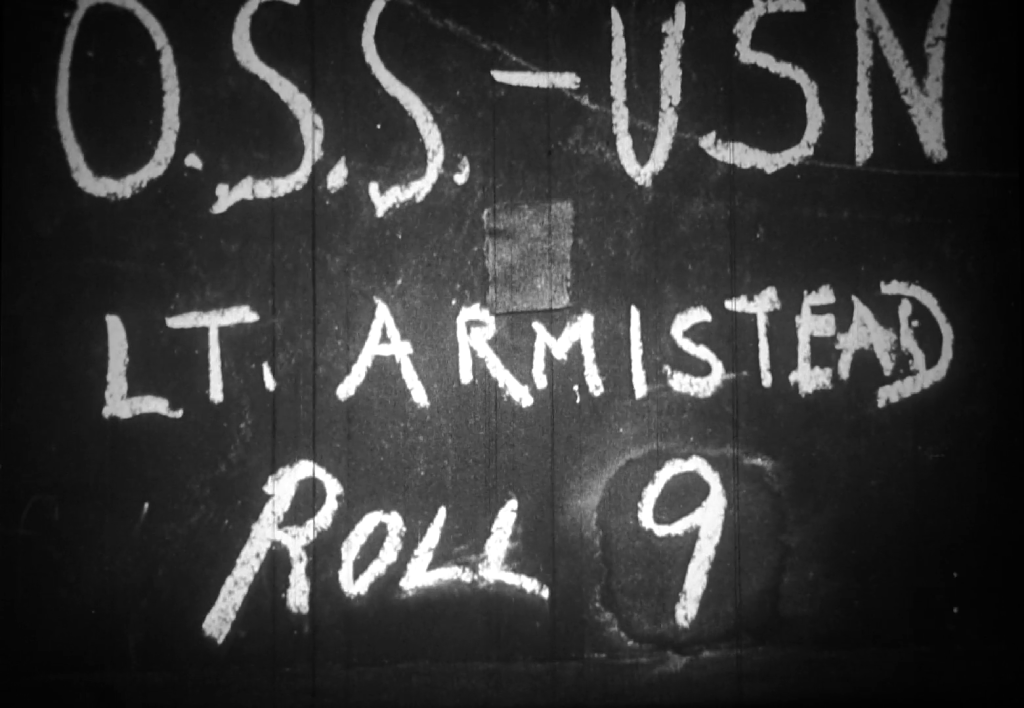
Regular readers of this blog know that written descriptions found at NARA are sometimes misleading, incomplete, incorrect, or missing all together. In this case the shot card for the film, shot by the US Navy and the Office of Strategic Services (“OSS”), identifies this as having been shot on August 11, 1944. That description may apply to the first part of the compiled reel, but the second half of the film includes the following slate:
We know from related research that Lt. Marcus Armistead was filming aboard PT boats in the channel on June 5th and 6th. Specifically, he was tagging along on missions by PT Boat Squadron 2(2). Commanded by Cmdr. John Bulkely, this small squadron of 3-4 “Higgins” PT boats was tasked with supporting special operations in the Channel, and running messages as needed.
Armistead was a veteran of “John Ford’s Navy”, a member of the veteran Hollywood director’s navy reserve unit which evolved into the “Field Photographic Branch” of the OSS. He was responsible for the testing and mounting of the fixed cameras installed on dozens of D-Day landing craft. He later moved onto several other projects for the OSS and the US Navy through the Korean War.
Need high impact archival footage to establish key points in your narrative? Context is critical to gain the full impact of archival film for your production. An experienced archival media researcher can leverage the full power of archives for you!


 Historicity Research Services