This World War II US Navy footage found at the National Archives and Records Administration shows combat footage from a minesweeping operation off of New Guinea. Unremarked for decades, a short segment of film at the end of this reel is unrelated footage from a camera affixed to a landing craft, LCI(L), off the coast of Normandy, France for the D-Day seaborne assault on Europe.
The National Archives on-line catalog entry contains the text of the US Navy’s shot descriptions. The last segment, starting at about 9:44, is undescribed. My sharp-eyed colleague, Tom Hogan, identified the footage. Based on unique physical characteristics of the boat, he has identified this as LCI(L)-88. That particular boat was one of several landing craft selected by the Office of Strategic Services (OSS) for the installation of a fixed motion picture film camera of the unloading operations.
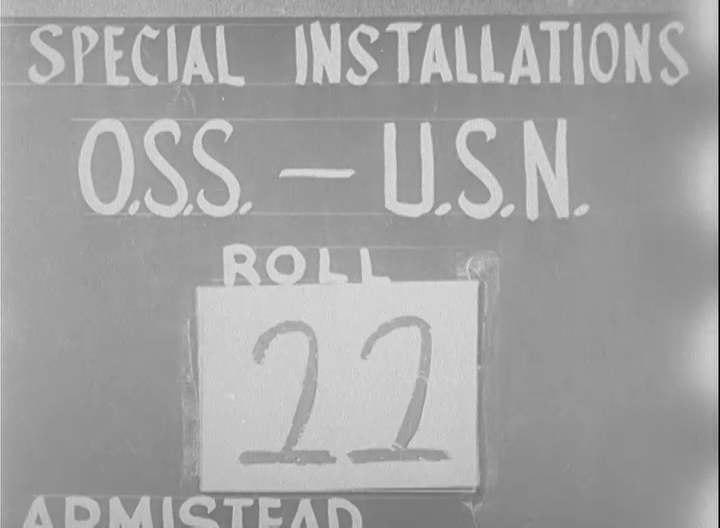
A team from the OSS’s “Field Photographic Division”, commanded by John Ford, spearheaded a crash program to install the cameras in April and May of 1944. Below is a screenshot of the prepared title that appears in this segment.
On-line descriptive material is sometimes incomplete, misleading or just plain wrong. A professional media researcher lends a critical eye to material available on-line. Add value to your project, presentation or publication!
Today’s film presents a mystery. The given title of this Army Air Forces (“AAF”) film found at the National Archives and Records Administration (“NARA”) is simply “Camp Activities”. This is the first of four rolls showing the construction and early operation of an Advanced Landing Ground airstrip in Normandy about 10 days after D-Day, making this one of the earliest Allied airfields in liberated France.
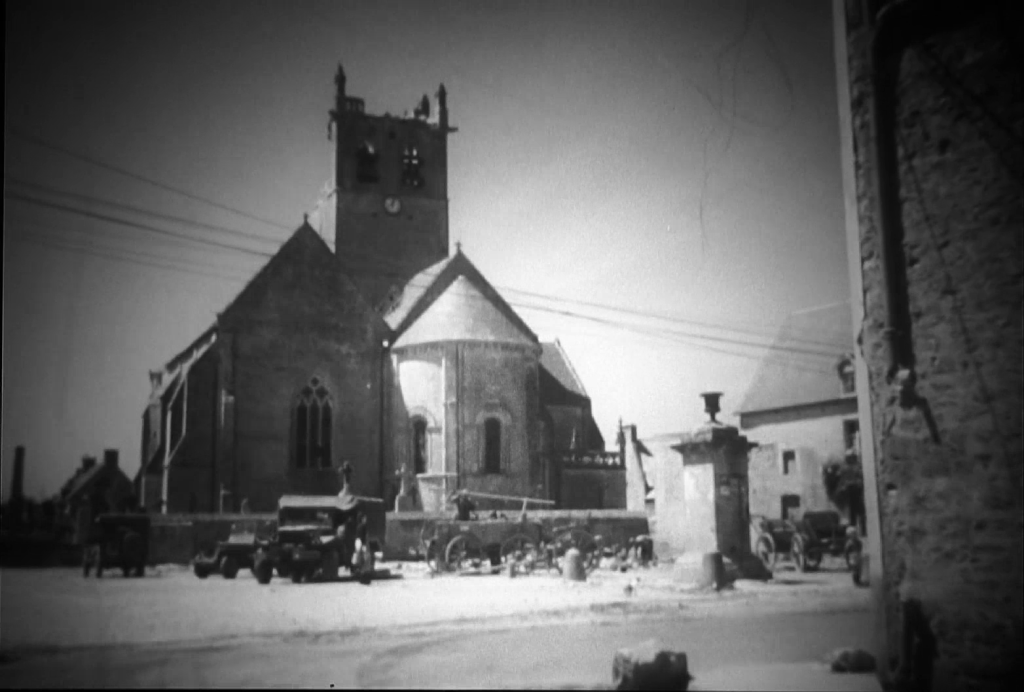
The description provided by the AAF provides no location and the only clue is a brief shot of a local church or abbey at 1:25. It looks like the back half of the church tower is missing.
The strip was apparently planted in a farmer’s field. The camp for Army personnel looks like it was setup next to one of Normandy’s numerous canals, but apparently the soldiers and airmen also setup in nearby wrecked gliders, suggesting this was a glider landing ground on D-Day. The film includes numerous shots of WWII aircraft: P-47 fighters, Spitfires, C-47’s, Horsa gliders, and CG-4A gliders in action (and also as wrecks on the ground).
My suspicion is that this was the Carentan Army Airfield (Advanced Landing Ground A-10), which is today the site of the Normandy Victory Museum. These airfields provided life-saving landing alternatives for aircraft and crews in trouble. They were often used to evacuate casualties as well. I’m hopeful that Norman locals can chime in here to help conclusively identify the site!
UPDATE!
Many thanks to my good friend and colleague Tom Hogan who identifed the church as Saint-Côme-du-Mont near Carentan. Further information received from a Normand suggests this is landing strip A-6, aka Beuzeville/Ste. Mère Eglise airstrip, since it was closer to the glider landing ground that figures so prominently in this film.
Context is critical to gain the full impact of archival film for your production. An experienced archival media researcher can leverage the full power of archives for you!
Our film today is from an Army Signal Corps roll of 35mm motion picture film, composited from several 100′ film camera reels. As I’ve come to expect, this reel is not fully described in the shot cards, likely because the Army catalogers did not have access to the original photographer’s “dope sheets” describing the film they took. The first three reels were from the “Special Installations” program, which mounted remotely operated, battery powered film cameras on D-Day landing craft.
The program was spearheaded by the Office of Strategic Services (“OSS”) Field Photographic Branch, which was commanded by legendary film director John Ford, and staffed by Hollywood veterans in Ford’s Naval Reserve unit. The officer in charge of the program, which involved significant modifications to the cameras, was Lt. Commander Marcus Armistead. The film depicts British or Canadian troops as they come out of the landing craft. Weather conditions the morning of June 6th were foggy, misty and spitting rain, which is why the film is low contrast. Later reels in this compilation including shots of a glider being towed by a C47 for the invasion and a couple of reels of pre-invasion activities, including troops being issued invasion currency, which they promptly throw dice for! The OSS folded operations in 1946 and the film they created was scattered among the CIA, Navy, Coast Guard, and Army Signal Corps film repositories. I captured the roll straight from the film “flatbed” viewer at the National Archives, so this copy doesn’t necessarily do the original film full justice.
Context is critical to gain the full impact of archival film for your production. An experienced archival media researcher can leverage the full power of archives for you!
Today we’re continuing our memory visit to Normandy’s Omaha Beach and specifically, the promontory at Pointe du Hoc. If you read our previous post, you know that the coastal artillery battery sited on this high ground was a primary objective for June 6th, the first day of the D-Day assault.
This battery sat atop a 100 foot high cliff and loomed large in Allied planning. The Ranger groups training in the United Kingdom spent months preparing for numerous cliff assault scenarios. The objective was assigned to the 2nd Ranger battalion. Thanks to their training and expert naval gunfire, they achieved their objectives. On reaching the summit, they discovered that a few weeks before D-Day, the captured French artillery making up this battery had been relocated to a nearby orchard. The Rangers found these large guns and disabled them with thermite grenades.
The “featured film” today, from the US Navy motion picture film material at the National Archives and Records Administration, is perhaps the earliest film of the aftermath of the Rangers’ assault. WARNING! This film shows dead casualties of the assault.
The film (identified by my sharp-eyed colleague, Thomas Hogan) opens with a scene of wounded being ferried back to the ships in the English Channel. The action quickly moves to a landing party that appears to be surveying the battlefield. Shell holes and abandoned equipment are all around the tide line. The camera quickly pans the high cliffs from below and settles on a precarious rope ladder. The landing party climbs the ladder, and the following shot scans a scene of desolation. The German strong points have all been demolished, if not by the Rangers, then by naval gunfire support. The party then climbs down the rope ladder, as the camera pans down, recording that the naval gunfire (falling short) had effectively pock marked the tidal zone with large craters. The following shots are heavily overexposed, and depicts a USO show taking place on the USS Texas.
The only available written description for these film is this (from the National Archives catalog): “This unedited film shows coastal gun batteries, dead German soldiers, and wounded US military personnel as they were moved from landing craft to the USS Texas (BB-35).” The film unmistakably depicts the scaling ladder used by the Rangers at Pointe du Hoc. The inadequate description, combined with the unremarkable title given: “Coastal Gun Batteries: Dead Germans” suggests that the initial catalogers may have not had access to any of the written documentation that should have accompanied the film. The film may have been taken by a Chief Photographer or Photographer’s mate from the USS Texas as part of the landing party. The state of the battlefield, with bodies un-recovered, suggest this may have been only a day or two after the Rangers’ assault. Because the invasion was planned for mid-tide, with an incoming tide, the fact that in the film the tide was low, suggests that this could have been shot on the afternoon of June 6th at the earliest.
U.S. Navy still photograph shows the rope ladder used by the Rangers at Pointe du Hoc
Inadequately described film materials are “par for the course” in government film archives and in many other contexts. The practiced, critical eye of a professional media researcher can ensure that your production, article or publication has the content you need to make a high-impact presentation.
This “found footage” from the National Archives and Records Administration (NARA) begins with casualties returning to England from the Normandy invasion. The last minute or two shows naval vessels shelling Omaha Beach. The high cliffs in the final shots are unmistakable as Pointe du Hoc, the highest point along the invasion beaches, the site of captured French 155mm artillery, and a target for the 2nd U.S. Army Ranger Battalion. Shot at eye-level, one can’t really make out the “point”, except for some shallow rocks. If you look carefully, in the last thirty seconds you can just make out the figures of troops at the foot of a scree slope before a tall cliff, without a lot of additional supplies, equipment and reinforcements. The tide is in as well, which builds a strong case that this is later in the morning of June 6th, so this could be the only moving image footage of the Rangers’ assault on the Axis position at Pointe du Hoc. Many thanks to sharp-eyed fellow researcher Thomas Hogan for identifying this film!
The included slates identify this as footage from Coast Guard, U.S. Navy and OSS cinematographers despite the reel being found in the holdings of the U.S. Army Signal Corps. OSS footage of the invasion is usually found in Record Group 428, the records of the Navy Photographic Center.
This footage is described in the NARA Catalog, but without identifying the location, so ordinarily, this footage would be overlooked. A knowledgeable researcher will recognize what they see. Choose a professional media researcher for your next production or publication! Researchers add value!
UPDATE:
Thanks to an upgraded 4K transfer from the archival film, I was able to locate the scene of the first section of the film, showing the incoming casualties returning to Britain as Weymouth Harbor, by identifying the business sign for “Cosen and Co Ltd”. Photographic Specialist Clarence “Sam” Moran was the photographer. He was 42 at the time of the invasion.
The photographer for the second segment was Lt. Cmdr. Allen G. Siegler, born in 1892 and was old enough to have registered for the draft in World War I. He had established a career as a cinematographer in Southern California beginning in 1914 and was an member of the American Society of Cinematographers. He would have been 52 years old at the time this film was taken. Both men were early volunteers for the Naval Reserve film unit founded by John Ford, which became the basis for the Field Photographic Branch of the Office of Strategic Services (OSS) the wartime predecessor of the Central Intelligence Agency.
Further research details that Lt. Cmdr. Siegler was detailed to the destroyer USS Satterlee (DD-626) during the invasion. The Satterlee is known to have the naval gunfire support mission for the Army Rangers assault on Pointe du Hoc. This help builds a strong circumstantial case that this was shot during the Rangers’ mission. Thanks to the extended resolution offered by a 4K transfer, we can clearly see details we only speculated on before. Landing craft pass from left to right in front of the camera, together with a Landing Craft Control ship. At about 9:19 you can clearly see figures moving at the base of a notch in a cliff face. This was all shot from quite a distance, on a moving ship, which makes the camera tracking ability in those final frames impressive!



 Historicity Research Services