This World War II US Navy footage found at the National Archives and Records Administration shows combat footage from a minesweeping operation off of New Guinea. Unremarked for decades, a short segment of film at the end of this reel is unrelated footage from a camera affixed to a landing craft, LCI(L), off the coast of Normandy, France for the D-Day seaborne assault on Europe.
The National Archives on-line catalog entry contains the text of the US Navy’s shot descriptions. The last segment, starting at about 9:44, is undescribed. My sharp-eyed colleague, Tom Hogan, identified the footage. Based on unique physical characteristics of the boat, he has identified this as LCI(L)-88. That particular boat was one of several landing craft selected by the Office of Strategic Services (OSS) for the installation of a fixed motion picture film camera of the unloading operations.
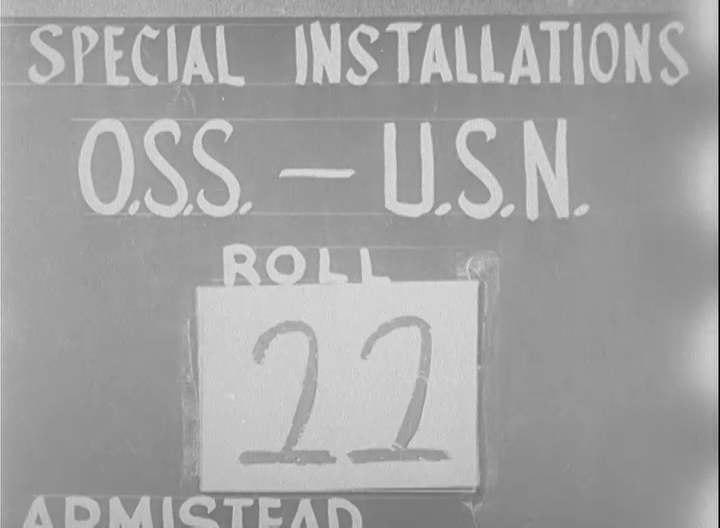
A team from the OSS’s “Field Photographic Division”, commanded by John Ford, spearheaded a crash program to install the cameras in April and May of 1944. Below is a screenshot of the prepared title that appears in this segment.
On-line descriptive material is sometimes incomplete, misleading or just plain wrong. A professional media researcher lends a critical eye to material available on-line. Add value to your project, presentation or publication!
Our film today is from an Army Signal Corps roll of 35mm motion picture film, composited from several 100′ film camera reels. As I’ve come to expect, this reel is not fully described in the shot cards, likely because the Army catalogers did not have access to the original photographer’s “dope sheets” describing the film they took. The first three reels were from the “Special Installations” program, which mounted remotely operated, battery powered film cameras on D-Day landing craft.
The program was spearheaded by the Office of Strategic Services (“OSS”) Field Photographic Branch, which was commanded by legendary film director John Ford, and staffed by Hollywood veterans in Ford’s Naval Reserve unit. The officer in charge of the program, which involved significant modifications to the cameras, was Lt. Commander Marcus Armistead. The film depicts British or Canadian troops as they come out of the landing craft. Weather conditions the morning of June 6th were foggy, misty and spitting rain, which is why the film is low contrast. Later reels in this compilation including shots of a glider being towed by a C47 for the invasion and a couple of reels of pre-invasion activities, including troops being issued invasion currency, which they promptly throw dice for! The OSS folded operations in 1946 and the film they created was scattered among the CIA, Navy, Coast Guard, and Army Signal Corps film repositories. I captured the roll straight from the film “flatbed” viewer at the National Archives, so this copy doesn’t necessarily do the original film full justice.
Context is critical to gain the full impact of archival film for your production. An experienced archival media researcher can leverage the full power of archives for you!
Nine years ago this September, I authored a post on the National Archives and Records Administration’s “Unwritten Record” blog about a mysterious film I found in NARA’s research rooms. I uncovered the fact that this artifact was likely the first “documentary treatment” of the Operation Overlord assault on the beaches of Normandy, D-Day, June 6th, 1944. The film is influential because the shot selections largely duplicate the footage provided to the newsreels around the same time. Those selections have imprinted the imagery of D-Day in our collective imagination.
The story going around at the time I found the film was that Hollywood “A list” director John Ford, wartime head of the Field Photographic Branch of the Office of Strategic Services (“OSS”), recalled his wartime experiences, recounting that his unit compiled an overall report on the invasion that was shown to FDR, Churchill, and Stalin. Ford recalled his experiences in a D-Day interview from “American Legion” magazine from June 1964 on the twentieth anniversary of D-Day. Having trained and equipped hundreds of photographers, Ford watched the first few days of the assault from the decks of the USS Plunkett, a Navy destroyer. In my post I made a strong circumstantial case that the film I found at the National Archives matches this description. A letter in the OSS personnel folder for Captain John Ford recommends him for the Distinguished Service Medal on the strength of his activities documenting the D-day invasion, specifically mentioning:
“The returning film was assembled under his directions, and an overall D-Day report, complete with sound, was competed on D plus 5, and was shown to Mr. Winston Churchill. Copies were also flown to President Roosevelt and Mr. Stalin.”
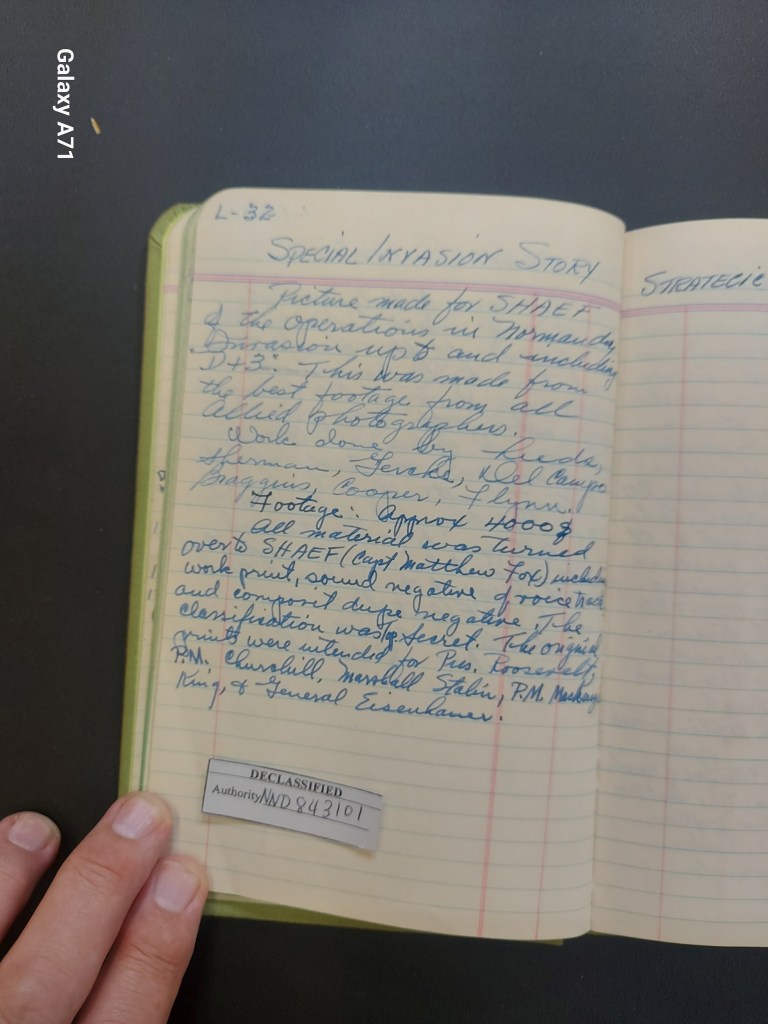
I was unable to verify these claims or make the link to my “found” film at the time of this earlier article. Thanks to some additional research I’ve undertaken at NARA, I’ve now made that link. Below, find an image from an OSS project log found in its London Field office files.
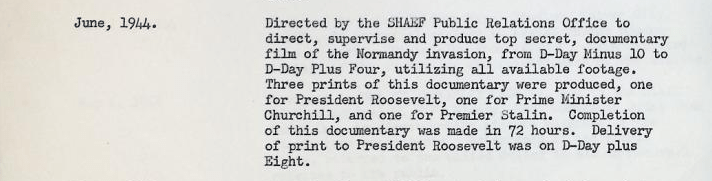
I was able to re-confirm this information in an “officer biography” found in the Official Military Personnel File for Frederick A. Spencer, Ford’s Chief Deputy at Field Photo.
These documents confirm that the production was intended for presentation to chiefs of state FDR, Churchill, and Stalin, adding that a print was delivered to FDR on D-Day plus 8, or June 14, 1944 and that the film was commissioned by the Supreme Headquarters Allied Expeditionary Forces (“SHAEF”) Public Relations Division (matching the film found at NARA). They contribute additional detail, too: that the original production was no more than “approx 4,000 ft”, or about 44 minutes (the finished production at NARA comes in at 33 minutes) and that the production elements (cut work print, sound negative, and composite duplicate negative were turned over to SHAEF. Finally, the project log gives the last names of OSS Field Photo personnel responsible for what had to be an epic 72 hour edit session that assembled this edit within days of the Operation Overlord assault.
Some details remain a mystery: those film elements remain to be found, the copy found at NARA appears to come from four work prints of uncertain provenance, also no production file from Field Photo has been found to date. The Field Photo assignment log also notes a copy was intendedto be made available to Canadian Prime Minister William Lyon Mackenzie King, but the Spencer biographical note lists only FDR, Churchill and Stalin. Hopefully, records of the presentation of these film reels to the “Big Three” will be found in the future.
Without further adieu, this is the “mystery film”…


 Historicity Research Services