
“CASE CLOSED” – Ending the Search for John Ford’s D-Day

62 years ago, in an article appearing in The American Legion magazine, film director John Ford recalled D-Day on the 20th anniversary of Operation Neptune, the naval assault on Normandy. Ford was in charge of Navy and Coast Guard photographic assets for the invasion. Confessing that his recollections were fuzzy and disconnected, Ford recalled the creation of hundreds of reels of black and white and color (Kodachrome) film and a 72-hour rush to edit their take. The final product, subject to wartime censorship, was released to the newsreels of the day. The newsreel “take” is what most Americans saw and remember to this day. 

Ford’s “missing” D-Day film quickly became encrusted with mythology. Author Stephen Ambrose and others repeated a claim that a film report in color of about 100 minutes was produced by Ford’s team. The reality is that hundreds of hours of D-Day film coverage, including some shot in color on 16mm Kodachrome film exist at the National Archives. The subject matter is mostly of the Naval side of the invasion. The film was shot by OSS photographers, as well as regular Navy and Coast Guard photographers under the command of Commander John Ford.

A film report was made by OSS Field Photographic, John Ford’s command, at the request of the Supreme Headquarters Allied Expeditionary Forces (SHAEF). The request was made on D+4, or June 10th, so little or no extra time was available for different edits.

This is the film I discovered, hiding in plain sight, at the National Archives in 2014. It used color film as a partial source, but the production was black and white. It was four reels, comprising about 33 minutes. No evidence of a color film version or a 100 minute edition has been found. Given what we know about the effort to produce the film, it’s unreasonable to expect multiple versions. This film was the product of the 72-hour edit session that Ford recalls.

Another “mystery” of D-Day combat photography is the question of the alleged film of the invasion shot by George Hjorth. He claimed that he shot multiple rolls of 16mm color film from a position behind German lines on the beach. In 2025, I discovered what is essentially the Field Photographic “production file” for the whole Navy/Coast Guard combat camera effort for Operation Neptune. In it is a letter written by Hjorth describing his combat stations during the invasion.

Hjorth was stationed on board the Destroyer Hobson (DD-464). He recounts witnessing the landing craft going in, naval rocket support firing, the sinking of the destroyer Cory and the recovery of survivors. Furthermore, he is described as being issued a Speed Graphic still camera and a bomb-spotter Eyemo camera (35mm motion picture camera), but not the 16mm film camera he claimed. Hjorth served in combat on D-Day with distinction, but his later claims of filming on the beaches of Normandy are not supported by any evidence.

Finally, there is the question of the possible loss of D-Day footage overboard, as an officer scrambled up a cargo net of a transport, returning from the beach with a duffel full of exposed film. I have heard the same story from many people that were in a position to know over many years. In my 2014 blog post for NARA, I found documents identifying Major William Ulman as having been tasked with retrieving exposed film at 0900 hours on Utah Beach on D-Day and returning without them. The documents state that he was unable to make contact with any photographers or caches of exposed film in time for his departure. Perhaps unfairly, many have identified Ulman as the officer noted. I will say that I have been unable to pin down an original source of the “duffel bag” story, so this may be one encrusted myth that survives, barely. 

Mysteries still exist with regard to D-Day combat camera operations. When did John Ford first go ashore after D-Day? Where are the original film and production file for the SHAEF/OSS film? For that matter, where are the original photographers’ “dope sheets” describing the D-Day film that was shot? Ultimately, John Ford himself has the last word, from “The Man Who Shot Liberty Valance”: “When the legend becomes fact, print the legend.” Perhaps whatever truths we find in the records, the legend abides.
Rediscovering WWII’s Forgotten Films: A Unique GI Adventure

Happy 2026 to all!

Today’s film is a forgotten piece of fluff found in the “Combat Subjects” series of the US Army Air Forces in WWII. Basically, a few GI’s find a derelict Kubelwagen (aka “German Jeep”) and decide to get it running again! Volkswagen resurrected the design in the late 60’s as “The Thing”.

The story was a welcome diversion from the grim tales of war. The fact that it has sound makes it stand out. Only a handful of films with composite sound are found in this series. There were a few ways to record sound optically but field recording was a different thing from commercial film. In this case the recording was likely made on transcription discs, later converted to an optical sound track in a lab.

Films like this are under-described in the National Archives on-line catalog, and are usually unavailable digitally. This particular film was recorded off the flatbed film viewers in NARA’s research room, no other digital copy exists. A professional media researcher can navigate the resources available in the research room and add value to your next production!

Posts

Latest from Historicity Research Services!

  • 62 years ago, in an article appearing in The American Legion magazine, film director John Ford recalled D-Day on the 20th anniversary of Operation Neptune, the naval assault on Normandy. Ford was in charge of Navy and Coast Guard photographic assets for the invasion. Confessing that his recollections were fuzzy and disconnected, Ford recalled the…

  • Today’s film highlights activities at an Airborne Glider Base in England in 1944 just before the D-Day invasion. The roll opens with airmen painting the invasion stripes on a glider and then a C-47. The base band rates a whole minute of film. The meat of the roll is four minutes (four camera rolls) of…

  • As part of an extended look back at D-Day for the 82nd anniversary of the assault on Hitler’s Europe, today’s film examines PT boat operations in Plymouth harbor and the English Channel. Regular readers of this blog know that written descriptions found at NARA are sometimes misleading, incomplete, incorrect, or missing all together. In this…

Back in the USSR!

Today’s film from the National Archives and Records Administration (“NARA”) illustrates a forgotten part of World War II, the titanic allied effort to arm and equip a future adversary: the Union of Soviet Socialist Republics (“USSR”). A major import channel for these supplies was through the Persian Gulf by way of a network of ports and airbases in Iran and Iraq.

This roll, shot by the US Army Air Forces in 1943, opens with the American star livery on an aircraft being repainted red for the Russians. Hundreds of large crates and ships suggest this a large, port, probably in Basra, Iraq. Enlisted personnel move crated aircraft around, opening one to reveal a “factory-fresh” Curtiss P-40 Warhawk fighter plane. Russian and American officers inspect the shipments and greet each other. The attitude illustrated is very much “the enemy of my enemy is my friend”!

Films like these aren’t well described in NARA’s on-line catalog, truly accessible only by those willing to work in the physical research rooms with the background granted by years of experience. Hire a professional researcher for your next production or publication and add impact!

“John Ford’s” D-Day Film – UPDATE!

Nine years ago this September, I authored a post on the National Archives and Records Administration’s “Unwritten Record” blog about a mysterious film I found in NARA’s research rooms. I uncovered the fact that this artifact was likely the first “documentary treatment” of the Operation Overlord assault on the beaches of Normandy, D-Day, June 6th, 1944. The film is influential because the shot selections largely duplicate the footage provided to the newsreels around the same time. Those selections have imprinted the imagery of D-Day in our collective imagination.

The story going around at the time I found the film was that Hollywood “A list” director John Ford, wartime head of the Field Photographic Branch of the Office of Strategic Services (“OSS”), recalled his wartime experiences, recounting that his unit compiled an overall report on the invasion that was shown to FDR, Churchill, and Stalin. Ford recalled his experiences in a D-Day interview from “American Legion” magazine from June 1964 on the twentieth anniversary of D-Day. Having trained and equipped hundreds of photographers, Ford watched the first few days of the assault from the decks of the USS Plunkett, a Navy destroyer. In my post I made a strong circumstantial case that the film I found at the National Archives matches this description. A letter in the OSS personnel folder for Captain John Ford recommends him for the Distinguished Service Medal on the strength of his activities documenting the D-day invasion, specifically mentioning:

“The returning film was assembled under his directions, and an overall D-Day report, complete with sound, was competed on D plus 5, and was shown to Mr. Winston Churchill. Copies were also flown to President Roosevelt and Mr. Stalin.”

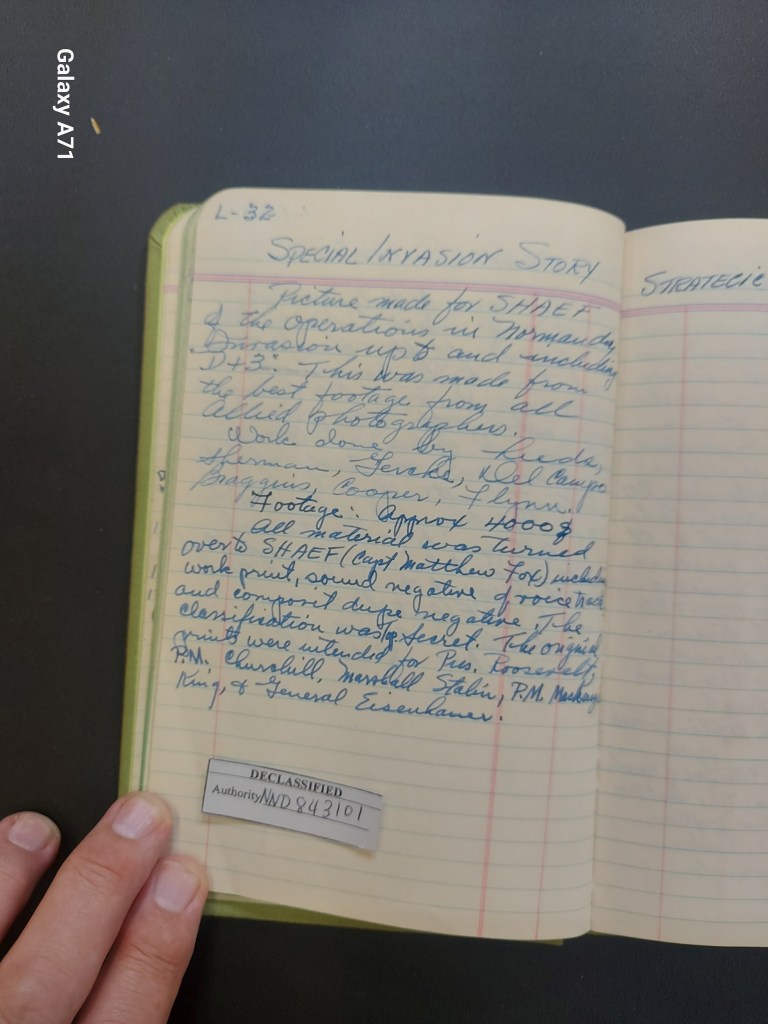
I was unable to verify these claims or make the link to my “found” film at the time of this earlier article. Thanks to some additional research I’ve undertaken at NARA, I’ve now made that link. Below, find an image from an OSS project log found in its London Field office files.

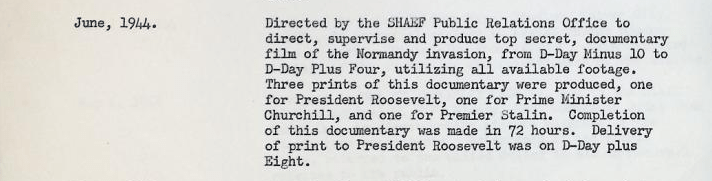
I was able to re-confirm this information in an “officer biography” found in the Official Military Personnel File for Frederick A. Spencer, Ford’s Chief Deputy at Field Photo.

These documents confirm that the production was intended for presentation to chiefs of state FDR, Churchill, and Stalin, adding that a print was delivered to FDR on D-Day plus 8, or June 14, 1944 and that the film was commissioned by the Supreme Headquarters Allied Expeditionary Forces (“SHAEF”) Public Relations Division (matching the film found at NARA). They contribute additional detail, too: that the original production was no more than “approx 4,000 ft”, or about 44 minutes (the finished production at NARA comes in at 33 minutes) and that the production elements (cut work print, sound negative, and composite duplicate negative were turned over to SHAEF. Finally, the project log gives the last names of OSS Field Photo personnel responsible for what had to be an epic 72 hour edit session that assembled this edit within days of the Operation Overlord assault.

Some details remain a mystery: those film elements remain to be found, the copy found at NARA appears to come from four work prints of uncertain provenance, also no production file from Field Photo has been found to date. The Field Photo assignment log also notes a copy was intended to be made available to Canadian Prime Minister William Lyon Mackenzie King, but the Spencer biographical note lists only FDR, Churchill and Stalin. Hopefully, records of the presentation of these film reels to the “Big Three” will be found in the future.

Without further adieu, this is the “mystery film”…

Aftermath of the Battle of Aachen

This reel is taken from a work print, a film element intended for editing purposes, and shows evidence of its age and a hard life. The film is one of hundreds of thousands at the National Archives and Records Administration (NARA) that remain unavailable digitally. For this particular roll, all that exists in the National Archives Catalog is a scan of an Army Signal Corps shot card. I shot this film from a flatbed film viewer in the public research room using a mirror-less digital camera.

The footage, dating from October 1944, shows the destruction wrought on the city of Aachen after many days of air and artillery bombardment followed by house-to-house street fighting. Civilian refugees struggle with their handful of possessions in suitcases through devastated streets. Sadly, such scenes of urban devastation seem very relevant today.

Only a professional researcher can provide timely access to such unseen archival footage and stills, adding impact to your production or publication.