Story of a Jeep: Much To Do About Nothing at All

Happy 2026 to all!

Today’s film is a forgotten piece of fluff found in the “Combat Subjects” series of the US Army Air Forces in WWII. Basically, a few GI’s find a derelict Kubelwagen (aka “German Jeep”) and decide to get it running again! Volkswagen resurrected the design in the late 60’s as “The Thing”.

The story was a welcome diversion from the grim tales of war. The fact that it has sound makes it stand out. Only a handful of films with composite sound are found in this series. There were a few ways to record sound optically but field recording was a different thing from commercial film. In this case the recording was likely made on transcription discs, later converted to an optical sound track in a lab.

Films like this are under-described in the National Archives on-line catalog, and are usually unavailable digitally. This particular film was recorded off the flatbed film viewers in NARA’s research room, no other digital copy exists. A professional media researcher can navigate the resources available in the research room and add value to your next production!

Back in the USSR!

Today’s film from the National Archives and Records Administration (“NARA”) illustrates a forgotten part of World War II, the titanic allied effort to arm and equip a future adversary: the Union of Soviet Socialist Republics (“USSR”). A major import channel for these supplies was through the Persian Gulf by way of a network of ports and airbases in Iran and Iraq.

This roll, shot by the US Army Air Forces in 1943, opens with the American star livery on an aircraft being repainted red for the Russians. Hundreds of large crates and ships suggest this a large, port, probably in Basra, Iraq. Enlisted personnel move crated aircraft around, opening one to reveal a “factory-fresh” Curtiss P-40 Warhawk fighter plane. Russian and American officers inspect the shipments and greet each other. The attitude illustrated is very much “the enemy of my enemy is my friend”!

Films like these aren’t well described in NARA’s on-line catalog, truly accessible only by those willing to work in the physical research rooms with the background granted by years of experience. Hire a professional researcher for your next production or publication and add impact!

Casablanca!

Today’s film, shot by US Army Air Forces photographers, presents no mysteries. Instead the reel is a gift that keeps on giving. Shot during President Roosevelt’s allied conference in early 1943, the film touches many bases. It opens with a segment of FDR meeting with Free French commander General Phillipe LeClerc and continues with a session showing FDR conferring with British Prime Minister Winston Churchill (good closeups!) The roll concludes with an early sound film of Roosevelt conferring the Congressional Medal of Honor on Col. William Wilbur as Generals George Marshall and George Patton look on. The sound segment continues with interviews of African American service members.

This film is barely described in the National Archives’ Catalog by the title “PRESIDENT ROOSEVELT & [AND] CHURCHILL AT CASABLANCA”. No digital surrogate is available on the Catalog. This copy was made by pointing a digital camera toward a vintage film work print on the flatbed film viewers provided in the National Archives’ Moving Image and Sound Research Room. As the work product of US government photographers, the film is uncopyrighted and available for use.

Content like this is usually ONLY screenable in the National Archives Research Rooms. Professional archival researchers can unlock unique content like this for your presentation, publication or production.

The “Camp Activities” Mystery: Discovering Normandy Airfields

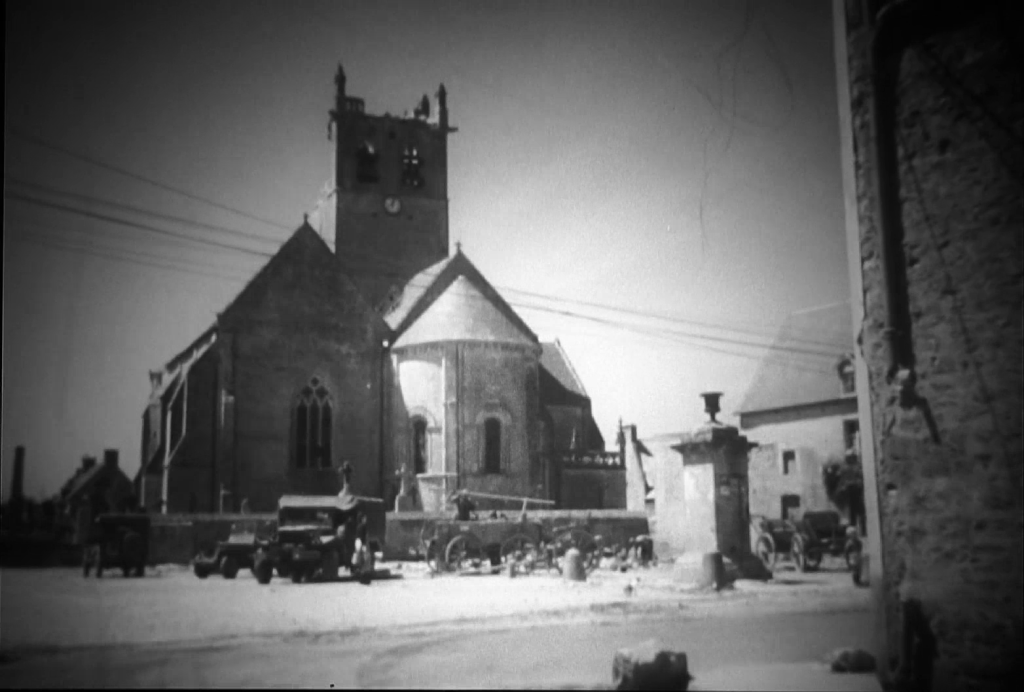
Today’s film presents a mystery. The given title of this Army Air Forces (“AAF”) film found at the National Archives and Records Administration (“NARA”) is simply “Camp Activities”. This is the first of four rolls showing the construction and early operation of an Advanced Landing Ground airstrip in Normandy about 10 days after D-Day, making this one of the earliest Allied airfields in liberated France.

The description provided by the AAF provides no location and the only clue is a brief shot of a local church or abbey at 1:25. It looks like the back half of the church tower is missing.

The strip was apparently setup in a farmer’s field. The camp for Army personnel looks like it was setup next to one of Normandy’s numerous canals, but apparently the soldiers and airmen also setup in nearby wrecked gliders, suggesting this was a glider landing ground on D-Day. The film includes numerous shots of WWII aircraft: P-47 fighters, Spitfires, C-47’s, Horsa gliders, and CG-4A gliders in action (and also as wrecks on the ground).

My suspicion is that this was the Carentan Army Airfield (Advanced Landing Ground A-10), which is today the site of the Normandy Victory Museum. These airfields provided life-saving landing alternatives for aircraft and crews in trouble. They were often used to evacuate casualties as well. I’m hopeful that Norman locals can chime in here to help conclusively identify the site!

UPDATE!

Many thanks to my good friend and colleague Tom Hogan who identifed the church as Saint-Côme-du-Mont near Carentan. Further information received from a Normand suggests this is landing strip A-6, aka Beuzeville/Ste. Mère Eglise airstrip, since it was closer to the glider landing ground that figures so prominently in this film.

Context is critical to gain the full impact of archival film for your production. An experienced archival media researcher can leverage the full power of archives for you!

The Dark Legacy of the German-American Bund

This short film was produced by the German-American Bund in the 1930’s as a promotional tool. It was later seized by the Department of Justice as part of an investigation of Fritz Kuhn, the Bund’s leader, on charges of being an unregistered agent of a hostile foreign government. The iconography of the Nazi swastika side-by-side with the flag of the United States underscores the fact that political extremism is an existential threat to a pluralistic, democratic society. Sadly, today the elected government of the United States is taking radical steps that remind us that eternal vigilance is the price of freedom. As John Stuart Mill said “Bad men need nothing more to compass their ends, than that good men should look on and do nothing.”

This is one brief story of among millions waiting to be told by using content available at the National Archives. An experienced professional researcher can leverage archival media to help bring your story alive.